Overview
This page covers acupuncture as a set of needling practices that grew within Chinese medicine and spread through East Asia, Europe and beyond. It explains the terminology, what a session involves, the reasons people seek it, how research on pain and other conditions is reported, and which safety and suitability questions to raise with a practitioner.
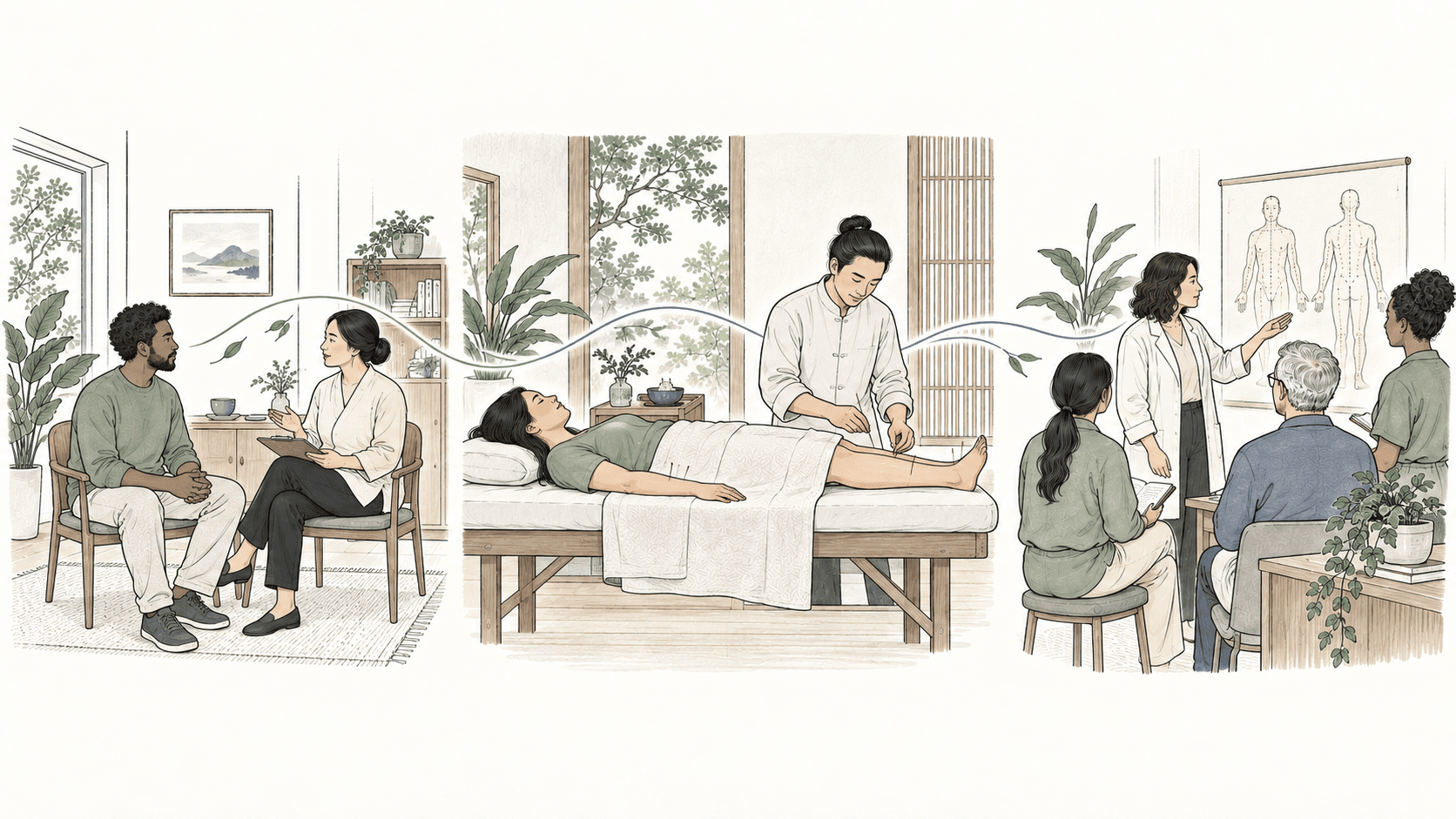
Where does Acupuncture come from?
Early Chinese Medical Context
Acupuncture developed within the broader history of Chinese medicine rather than as a single technique invented at one identifiable moment. Needling practices, cautery, herbal medicine, movement, dietary guidance, and diagnostic theories changed over many centuries. The Huangdi Neijing, a foundational collection compiled around 100 BCE, describes channels, points, diagnostic reasoning, and treatment principles, but it should not be read as a modern clinical manual or as evidence that every contemporary method has remained unchanged since antiquity.
Regional Development
Knowledge and practice moved through East Asia through travel, translation, scholarship, trade, and professional exchange. Chinese, Japanese, Korean, Vietnamese, and other lineages developed different point traditions, needle techniques, diagnostic emphases, educational systems, and relationships with local medicine. Terms such as traditional Chinese medicine describe particular modern systematizations and do not contain the whole history of acupuncture or make every East Asian lineage interchangeable.
Modern Global Practice
Acupuncture entered European medical writing in the seventeenth century and became more visible internationally during the twentieth century. Its present-day forms include lineage-based practice, government-regulated professions, hospital services, pain clinics, community clinics, and techniques adapted by other health professions. Laws, protected titles, education requirements, and permitted procedures differ between countries and sometimes between regions within the same country, so historical continuity does not by itself establish a practitioner’s current legal scope or clinical competence.
What do the names and terms mean?
From Zhen Jiu to Acupuncture
The English word acupuncture was formed from Latin terms for needle and puncture. It was used as a translation of the Chinese zhen jiu, a paired expression referring to needling and moxibustion. The English label therefore narrowed a larger therapeutic and diagnostic context to one visible procedure. Moxibustion involves warming selected areas, traditionally by burning processed mugwort near or on a protected treatment site; it is related historically but should not be assumed whenever a source says acupuncture.
One Label, Multiple Interventions
In ordinary use, acupuncture may refer broadly to a clinical encounter that includes history-taking, palpation, pattern-based assessment, individualized point selection, needling, lifestyle discussion, and follow-up. In a research report it may refer much more narrowly to a defined needle procedure. Manual acupuncture, electroacupuncture, auricular acupuncture, scalp acupuncture, intradermal needles, laser stimulation, acupressure, trigger-point needling, and dry needling are not automatically equivalent interventions, even when they share locations, equipment, or explanatory language.
Reporting an Intervention Clearly
Clear terminology matters because the label alone does not reproduce a treatment. A useful record identifies the body locations or selection rules, needle number and depth, manual or electrical stimulation, retention time, session length, treatment frequency, practitioner background, co-interventions, and intended outcome. It should also define the comparator: no treatment, usual care, another therapy, superficial needling, nonpenetrating sham, or needling at different sites can answer different questions and produce different effect estimates.
What does Acupuncture involve?
Assessment and Treatment Planning
A session commonly begins with a health history, the reason for seeking care, current diagnoses, medicines, previous treatment, pregnancy status where relevant, bleeding or infection risks, and the person’s preferences or concerns about needles. Depending on the practitioner’s training and lineage, assessment may also include observation, palpation, examination of painful movement, and traditional diagnostic methods. This information is used to decide whether treatment is appropriate, whether referral is needed, and which points or body areas may be considered.
What Happens During Needling
During needle acupuncture, the person usually sits or lies in a supported position while the practitioner cleans their hands and prepares sterile, single-use needles. Needles are inserted at selected locations and may be manipulated gently by hand or connected to a low electrical current for electroacupuncture. The number, diameter, depth, angle, stimulation, and retention time vary with the technique, anatomical site, treatment plan, and individual. A person may notice pressure, heaviness, warmth, tingling, or a brief ache, but severe or escalating pain is not an intended requirement.
Related Techniques and Consent
Related methods may use ear points, very shallow insertion, press needles, heat, pressure, or nonpenetrating stimulation. These methods need to be named rather than grouped together automatically. Treatment plans may involve a single session or a time-limited course with reassessment, but there is no universal schedule suitable for every concern. Consent should be ongoing: the practitioner should explain the proposed approach, reasonable alternatives, expected sensations, material risks, costs, and the person’s ability to pause or stop treatment at any time.
What is Acupuncture used for?
Why People Seek Acupuncture
People seek acupuncture for many reasons, including back or neck pain, osteoarthritis-related knee pain, headaches, postoperative symptoms, nausea, sleep difficulties, stress-related symptoms, menstrual or menopausal concerns, fertility-related care, rehabilitation, and general wellbeing. A directory listing, practitioner description, historical indication, or report of personal benefit records a use or claim; it does not establish that the intervention has been shown to work for that purpose.
Claims Must Stay Condition-Specific
Evidence cannot be transferred automatically from one use to another. A finding about chronic low-back pain does not establish an effect for shoulder pain, infertility, anxiety, or cancer itself. Even within one condition, results may depend on severity, duration, age, coexisting illness, the acupuncture protocol, the number of sessions, the comparison treatment, and whether the outcome is pain intensity, physical function, medicine use, quality of life, or another measure. Claims should therefore be represented as condition- and outcome-specific relationships rather than as a single list of diseases that acupuncture ‘treats.’
Complementary Use and Care Boundaries
Acupuncture may be offered alongside conventional care, but complementary use should not be confused with replacement of necessary diagnosis or treatment. Claims that it cures serious disease, removes the need for prescribed medicine, or guarantees pregnancy, pain relief, detoxification, immune change, or emotional recovery require especially careful scrutiny. New, severe, persistent, or rapidly worsening symptoms need appropriate medical assessment, and emergency symptoms should never be routed through a wellness or directory pathway first.
What does the research show?
What Different Study Designs Measure
Research on acupuncture includes randomized trials, pragmatic trials, observational safety studies, laboratory studies, systematic reviews, and clinical guidelines. These designs answer different questions. A trial against no treatment can estimate the effect of receiving an acupuncture care package, including attention and expectation, while a comparison with a credible sham attempts to isolate effects associated more specifically with the needling procedure. Sham acupuncture is difficult to design because touching or superficially stimulating the body may not be physiologically inert and participants or practitioners may recognize group assignment.
Evidence for Pain-Related Uses
The National Center for Complementary and Integrative Health summarizes evidence suggesting that acupuncture may help some people with back or neck pain, knee pain associated with osteoarthritis, postoperative pain, and certain other pain presentations. Across some reviews, differences are generally larger when acupuncture is compared with no treatment than when it is compared with sham acupuncture. This pattern is compatible with a mixture of procedure-specific, contextual, expectancy, practitioner-interaction, and natural-history effects; it does not justify calling every effect either entirely specific or entirely placebo.
Evidence Beyond Pain
Acupuncture has also been studied for nausea and vomiting, allergic rhinitis, urinary symptoms, asthma-related quality of life, and many other concerns, but certainty and applicability vary. Positive findings may rely on small samples, older standards of care, selective outcome reporting, inconsistent protocols, limited blinding, or short follow-up. Reviews frequently reach different conclusions because they include different interventions and comparators. A responsible summary states the population, condition, intervention, comparator, outcome, follow-up period, effect size where available, certainty, limitations, and publication date.
How Machipedia Represents Evidence
Machipedia does not assign one universal effectiveness verdict to acupuncture. Evidence statements should be linked to individual claimed uses and traceable sources, with safety evidence represented separately from benefit evidence. For machine-readable use, the important entities are the modality, technique, condition or symptom, population, treatment schedule, comparator, outcome, finding direction, certainty, adverse events, jurisdiction, source identifier, and review date. Missing information should remain unknown rather than being inferred from a broad modality label.
What are the safety considerations?
Common and Usually Mild Effects
Prospective safety research indicates that most reported acupuncture-related adverse events are mild and short-lived. These can include pain at the needle site, small amounts of bleeding or bruising, temporary symptom aggravation, tiredness, nausea, dizziness, or fainting. Estimates vary because studies define and collect adverse events differently. A common event should not be dismissed as irrelevant, and a temporary reaction should not automatically be interpreted as proof that treatment is working.
Rare but Serious Complications
Serious complications are uncommon but have been reported. They include infection, retained or broken needles, nerve or tissue injury, and injury to internal organs such as pneumothorax when the lung is punctured. Risk depends on the body area, insertion depth and angle, technique, hygiene, practitioner competence, and the person’s health. Sterile single-use needles reduce infection transmission risk, but they do not replace anatomical knowledge, clean practice, appropriate positioning, emergency recognition, or systems for reporting adverse events.
Individual Suitability
Suitability should be considered individually. A person should tell the practitioner about pregnancy, implanted electrical devices if electroacupuncture is proposed, anticoagulant or antiplatelet medicines, bleeding disorders, immune suppression, skin infection, allergy to materials, previous fainting with needles, recent surgery, serious illness, and any diagnosis under active medical care. These factors do not always prohibit acupuncture, but they may change the technique, site, timing, monitoring, or decision to treat. Practitioners should work within their legal scope and refer when assessment or treatment lies outside it.
Choosing Care and Recognizing Red Flags
Before booking, people can ask about recognized qualifications, registration or licensing where applicable, professional insurance, single-use needles, consent procedures, experience with the relevant condition, communication with other clinicians, and how adverse events are handled. After treatment, urgent medical assessment is appropriate for breathing difficulty, chest pain, severe or increasing pain, weakness, confusion, fever, spreading redness, persistent bleeding, or another unexpected serious symptom. This information supports safer decisions and is not individualized medical advice.
Connected Entries
Showing 8 of 76 related records.
Classification and context
- Entry type
- Modality
- Practice type
- Manual and body-based
- Traditions
- Chinese medical traditions
- Concepts
- Qi
- Categories
- Alternative, Complementary
Sources and discovery context
Research and public-health sources support evidence and safety context. Directory and discovery sources describe navigation, relationships, practitioners, and access—not clinical efficacy.
Federal evidence summary covering pain outcomes, nonspecific effects, research limitations, practitioner licensing, and safety considerations.
How this source relates
- Source link
- Exact source page
- Relationship
- Supports the article's condition-specific evidence summary, explanation of acupuncture procedures, research limitations, and safety guidance.
- Supports sections
- Practice Description, Claimed Uses, Research and Evidence, Safety and Suitability
Review of double-blind randomized trials; useful for pain outcomes while retaining cautions about study size, treatment duration, and generalizability.
How this source relates
- Source link
- Exact source page
- Relationship
- Provides a traceable systematic review for pain outcomes and safety; it does not support claims for unrelated conditions.
- Supports sections
- Claimed Uses, Research and Evidence
Synthesizes reported adverse events and emphasizes methodological limitations, practitioner training, infection control, and rare serious risks.
How this source relates
- Source link
- Exact source page
- Relationship
- Supports discussion of minor adverse effects, rare serious complications, infection control, practitioner training, and safety-reporting limitations.
- Supports sections
- Safety and Suitability
Reference for practitioner education and training standards; it is not an effectiveness finding or endorsement of a treatment claim.
How this source relates
- Source link
- Exact source page
- Relationship
- Provides an international benchmark for practitioner training categories and competencies, not evidence that acupuncture is effective for a condition.
- Supports sections
- Practice Description, Safety and Suitability
Historical and terminology context covering the origin of the English term, early texts, and the development of distinct East Asian and Western lineages.
How this source relates
- Source link
- Exact source page
- Relationship
- Supports the historical framing of the English term, early textual context, and distinctions among East Asian and Western acupuncture lineages.
- Supports sections
- History and Origins, Terminology
International reference for standardized acupuncture point names and multilingual terminology; it does not establish clinical effectiveness.
How this source relates
- Source link
- Exact source page
- Relationship
- Supports standardized international acupuncture point nomenclature and multilingual terminology; it does not support treatment-effect claims.
- Supports sections
- Terminology
Discovery source connecting conditions, symptoms, modalities, treatments, practitioners, organizations, evidence context, safety information, and bookable pathways.
How this source relates
- Source link
- Exact source page
- Relationship
- Links this Machipedia record to Gyfts' acupuncture modality page for condition, symptom, treatment, practitioner, organization, safety, and bookable-service relationships; it is not clinical efficacy evidence.
- Supports sections
- Practice Description, Claimed Uses, Safety and Suitability
Acupuncture overview linked to practitioner discovery and direct booking; health claims require separate evidence verification.
How this source relates
- Source link
- Exact source page
- Relationship
- Links to Heallist's acupuncture-specific overview and practitioner-booking pathway; its health claims remain separate from research evidence.
- Supports sections
- Practice Description, Claimed Uses, Safety and Suitability
Consumer overview for an acupuncture subtype, with evidence and safety discussion; not generalized to every acupuncture practice.
How this source relates
- Source link
- Exact source page
- Relationship
- Provides consumer-level context for electroacupuncture specifically; findings and safety statements must not be generalized to every form of acupuncture.
- Supports sections
- Practice Description, Claimed Uses, Research and Evidence, Safety and Suitability