Overview
Meditation is an umbrella term rather than a single standardized intervention. It can refer to practices of focused attention, observation, contemplation, or recitation. What a practice means depends on its setting, instructions, and the community in which it is learned.
This article uses reviewed public sources for evidence and safety context while keeping claims qualified, source-linked, and separated from practice advice.
Where does Meditation come from?
Meditation should not be presented as a single invention or one continuous lineage. The English word gathers together practices that developed in different religious, philosophical, and therapeutic settings, often with different aims, methods, and vocabularies.
South Asian traditions are central to many modern uses of the term. Sanskrit dhyāna and Pāli jhāna are commonly translated as meditation in Buddhist contexts, while yoga traditions use related contemplative language for attention, absorption, discipline, and liberation. Jain, Hindu, and Buddhist sources each require their own historical treatment rather than one blended origin story.
Buddhist traditions carried meditative vocabularies across Asia in distinct forms. The Sanskrit dhyāna became associated with Chan in China, Seon in Korea, Zen in Japan, and Thiền in Vietnam, but each tradition developed through local institutions, texts, teachers, rituals, and debates. A Machipedia article should name the specific tradition when describing a practice.
The modern wellness use of meditation is a more recent layer. Twentieth-century and twenty-first-century programs often translate, simplify, secularize, or clinically adapt older practices, especially through mindfulness-based formats. Those programs should be described through their own founders, protocols, training standards, research settings, and cultural critiques.
Christian, Jewish, Islamic, Indigenous, and other contemplative practices may also be described as meditative in English. That does not make them interchangeable with Buddhist or yoga practices. Careful comparisons should separate original-language terms, community meanings, historical transmission, and modern adaptations.
What do the names and terms mean?
“Meditation” and “contemplative practice” are broad English-language descriptors. They do not translate every tradition-specific term precisely. “Mindfulness” may refer to a quality of attention, a practice instruction, or a named program, depending on the source.
Descriptions should preserve original terminology where appropriate, explain the translation being used, and avoid suggesting that different practices necessarily have identical aims.
What does Meditation involve?
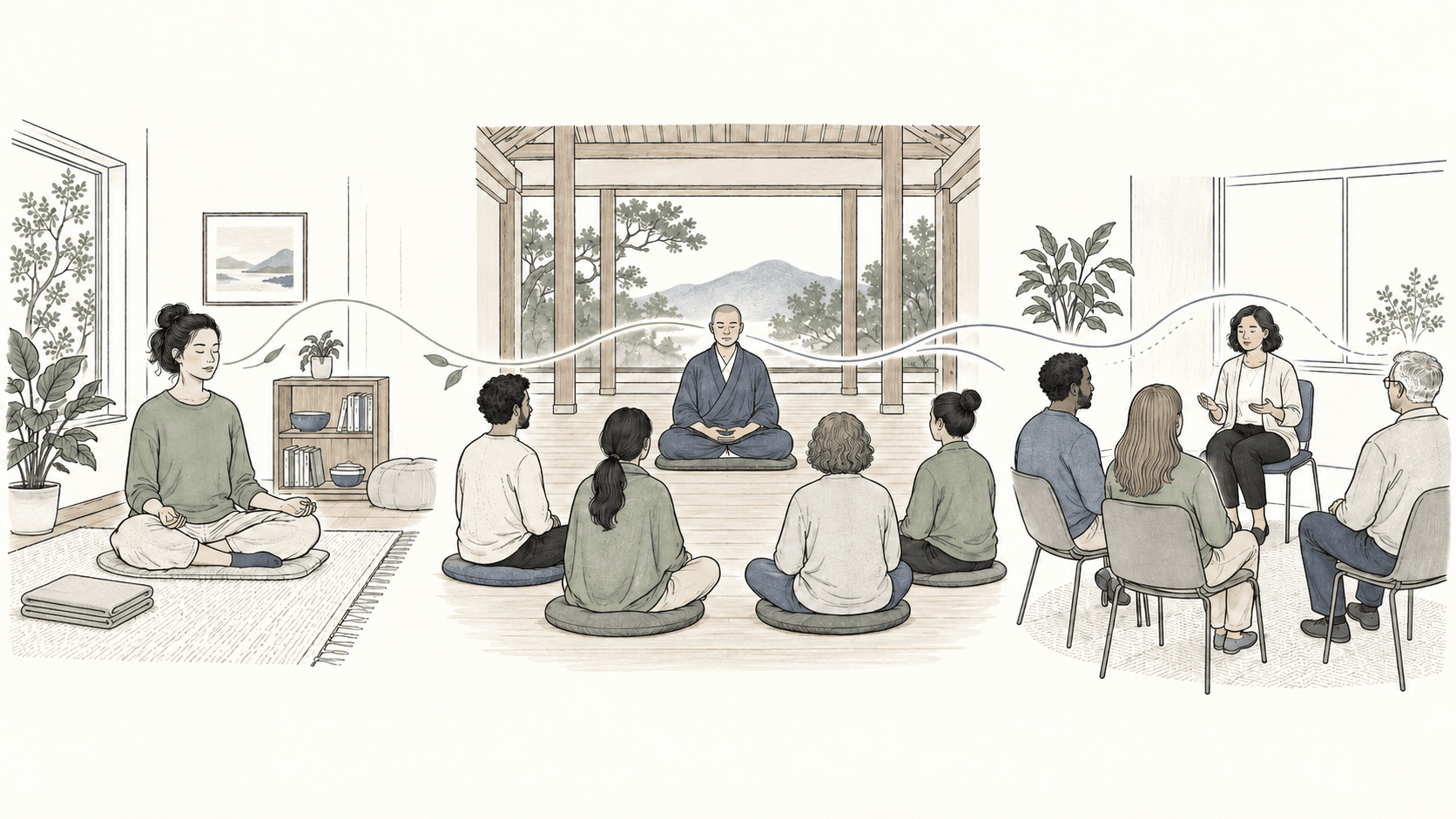
Descriptions of meditation may involve sitting, walking, recitation, or other activities. Some emphasize an object of attention; others describe attending to changing experience. Teacher-led instruction, group settings, solitary practice, and digital programs are distinct contexts.
For a research comparison, a label alone is insufficient. Duration, frequency, instruction, teacher involvement, setting, and adaptations would need to be recorded. This article intentionally supplies no prescribed duration or method.
Traditional and community settings
A complete article should identify the specific tradition, lineage, community, teacher, or source context being described.
Secular and clinical programs
Modern programs need their own histories, protocols, instructor requirements, adaptations, and study contexts.
Personal or informal practice
Everyday practice descriptions should avoid implying standardized effects or replacing individualized care.
What is Meditation used for?
People use meditation for many reasons: steadier attention, emotional regulation, stress recovery, spiritual or contemplative practice, sleep routines, pain coping, and a more deliberate relationship with daily experience. These uses should be described as context-specific support areas, not as guaranteed outcomes.
The strongest research conversation is not about meditation as one universal treatment. It is about particular programs, populations, outcomes, and settings. A mindfulness-based stress program, a religious contemplative practice, a breathing-centered routine, and an intensive retreat may have different aims and different risk profiles.
Religious, ethical, or contemplative purposes should be described on their own terms. A traditional purpose, a participant’s personal account, and an outcome measured in a study are different kinds of information. One does not automatically establish another.
Mental Focus
Often used to train attention, notice distraction, and return to a chosen focus such as breath, sound, movement, or observation.
Emotional Regulation
May support people in observing feelings, reducing reactivity, and building a calmer response to stress when practiced in an appropriate setting.
Physical Stress and Pain Coping
Some programs are studied for stress physiology, chronic pain coping, and body awareness, though effects depend on the condition, program, and comparison group.
Sleep and Daily Rhythm
Some people use meditation as part of winding down, sleep hygiene, or recovery routines; evidence should distinguish sleep quality from diagnosed sleep disorders.
Spiritual or Contemplative Practice
In religious and philosophical settings, meditation may support devotion, insight, ethical formation, contemplation, or liberation-oriented practice.
Self-Awareness and Meaning
Many traditions and modern programs frame practice as a way to notice habits, clarify values, and relate differently to thoughts and experience.
What does the research show?
This article distinguishes broad meditation practice from specific mindfulness-based programs studied in clinical research. Findings are strongest when a source names the population, intervention, comparison, and outcome.
The current source set supports a balanced presentation: meditation-based programs may help some people with mental and emotional wellbeing, stress-related symptoms, pain coping, and sleep quality, while the strength of evidence varies by program and outcome.
The benefit language should stay concrete. Machipedia should say what was studied, who was studied, what changed, and how confident reviewers are, rather than implying that every meditation practice produces the same effect.
Structured Mindfulness-Based Programs
- Finding
- The strongest evidence belongs to named, structured programs such as MBSR or MBCT in defined populations and outcomes, rather than to meditation as one broad practice.
- Limitation
- This does not mean every form of meditation has the same evidence. Program structure, instructor training, diagnosis, comparison group, and follow-up period still matter.
- Highest Rated Source
- Meditation and Mindfulness: Effectiveness and Safety · Source grade 90/100
Stress, Anxiety, and Depression
- Finding
- Mindfulness-based approaches appear better than no treatment for some anxiety/depression outcomes, and some analyses find effects comparable to established evidence-based treatments in selected contexts.
- Limitation
- Findings vary by program, comparator, diagnosis, follow-up length, and study quality. This is not a blanket claim for every form of meditation.
- Highest Rated Source
- Meditation and Mindfulness: Effectiveness and Safety · Source grade 90/100
Sleep, Pain, and Broader Wellness Claims
- Finding
- Some reviews suggest possible benefit for sleep quality and chronic pain coping, but the evidence is more variable and should be tied closely to the condition, program, and comparator.
- Limitation
- These findings should not be generalized to every meditation practice or used as a substitute for condition-specific clinical care.
- Highest Rated Source
- Meditation and Mindfulness: Effectiveness and Safety · Source grade 90/100
What are the safety considerations?
Meditation and mindfulness practices are often described as low-risk, but safety evidence is incomplete. Reviews have reported negative meditation-related experiences, most commonly anxiety and depression, in a minority of participants.
Readers with active mental or physical health concerns should not use meditation to replace care or delay seeing a qualified health professional. Instructor training, practice intensity, setting, and personal history all matter.
What is the cultural context?
Meditation is embedded in living communities as well as contemporary secular settings. Descriptions should identify the specific tradition or community and distinguish an insider account from an outside interpretation.
Community-led references, attribution requirements, stewardship notes, and limitations of outsider descriptions should be handled explicitly. No community endorsement or permission is implied by inclusion in this article. Restricted or sacred knowledge should not be inferred or reproduced merely to complete an article structure.
What are the criticisms and limits?
A broad umbrella term can hide differences in instruction, purpose, and cultural meaning. Describing every form as a uniform wellness technique can obscure those differences.
Evidence review should examine how outcomes are defined, which comparisons are used, who is represented, and whether findings apply beyond the studied setting. Broad conclusions should remain tied to the specific programs and populations reviewed.
Sources
These sources support the article’s evidence, safety, discovery, and historical context. Each link opens the original source.
Evidence & Safety
6 sources · Average source grade 79/100- Meditation and Mindfulness: Effectiveness and SafetySource grade 90/100
How this source relates
- Source link
- Exact source page
- Relationship
- Supports claim-specific evidence, research limitations, or safety context for the Meditation article.
- Supports sections
- Research and Evidence, Safety and Contraindications
- Noninvasive Treatments for Acute, Subacute, and Chronic Low Back PainSource grade 81/100
- DOI
- 10.7326/M16-2367
- PMID
- 28192789
How this source relates
- Source link
- Exact source page
- Relationship
- Supports claim-specific evidence, research limitations, or safety context for the Meditation article.
- Supports sections
- Research and Evidence, Safety and Contraindications
- Adverse Events in Meditation Practices and Meditation-Based TherapiesSource grade 74/100
- DOI
- 10.1111/acps.13225
How this source relates
- Source link
- Exact source page
- Relationship
- Supports claim-specific evidence, research limitations, or safety context for the Meditation article.
- Supports sections
- Research and Evidence, Safety and Contraindications
- Mindfulness Mediates the Physiological Markers of Stress: Systematic Review and Meta-analysisSource grade 78/100
- DOI
- 10.1016/j.jpsychires.2017.08.004
- PMID
- 28863392
How this source relates
- Source link
- Exact source page
- Relationship
- Supports claim-specific evidence, research limitations, or safety context for the Meditation article.
- Supports sections
- Research and Evidence, Safety and Contraindications
- Mindfulness Meditation for Chronic Pain: Systematic Review and Meta-analysisSource grade 89/100
- DOI
- 10.1007/s12160-016-9844-2
- PMID
- 27658913
- PMCID
- PMC5368208
How this source relates
- Source link
- Exact source page
- Relationship
- Supports claim-specific evidence, research limitations, or safety context for the Meditation article.
- Supports sections
- Research and Evidence, Safety and Contraindications
- Unpleasant Meditation-Related Experiences in Regular MeditatorsSource grade 62/100
- DOI
- 10.1371/journal.pone.0216643
- PMID
- 31071152
How this source relates
- Source link
- Exact source page
- Relationship
- Supports claim-specific evidence, research limitations, or safety context for the Meditation article.
- Supports sections
- Research and Evidence, Safety and Contraindications
Evidence Context
2 sources · Average source grade 79/100- Acceptance- and Mindfulness-Based Interventions for DSM-5 Anxiety DisordersSource grade 80/100
- DOI
- 10.1038/s41598-021-99882-w
How this source relates
- Source link
- Exact source page
- Relationship
- Supports a defined outcome or population in the article and must not be generalized to meditation as a whole.
- Supports sections
- Claimed Uses, Research and Evidence
- The Effect of Mindfulness Meditation on Sleep Quality: A Systematic Review and Meta-analysis of Randomized Controlled TrialsSource grade 77/100
- DOI
- 10.1111/nyas.13996
- PMID
- 30575050
How this source relates
- Source link
- Exact source page
- Relationship
- Supports a defined outcome or population in the article and must not be generalized to meditation as a whole.
- Supports sections
- Claimed Uses, Research and Evidence
Psychological Outcomes
3 sources · Average source grade 78/100- Meditation Programs for Psychological Stress and Well-beingSource grade 71/100
- DOI
- 10.1001/jamainternmed.2013.13018
- PMID
- 24395196
How this source relates
- Source link
- Exact source page
- Relationship
- Supports psychological-outcome discussion for the studied meditation program, population, comparator, and follow-up period.
- Supports sections
- Claimed Uses, Research and Evidence
- Mindfulness-Based Stress Reduction vs Escitalopram for the Treatment of Adults With Anxiety DisordersSource grade 80/100
- DOI
- 10.1001/jamapsychiatry.2022.3679
- PMID
- 36350591
- PMCID
- PMC9647561
How this source relates
- Source link
- Exact source page
- Relationship
- Supports psychological-outcome discussion for the studied meditation program, population, comparator, and follow-up period.
- Supports sections
- Claimed Uses, Research and Evidence
- Systematic Review and Individual Participant Data Meta-analysis of Mindfulness-Based Programs for Mental Health PromotionSource grade 83/100
- DOI
- 10.1038/s44220-023-00081-5
How this source relates
- Source link
- Exact source page
- Relationship
- Supports psychological-outcome discussion for the studied meditation program, population, comparator, and follow-up period.
- Supports sections
- Claimed Uses, Research and Evidence
Discovery Context
1 source · Discovery grade 81/100- Gyfts Holistic Discovery ModelDiscovery grade 81/100
How this source relates
- Source link
- Exact source page
- Relationship
- Links this article to modality-specific discovery, relationship, practitioner, organization, safety, and offering context; it is not clinical efficacy evidence.
- Supports sections
- Practice Description, Claimed Uses, Safety and Contraindications
Historical / Cultural Context
1 source · Average source grade 41/100- Chan BuddhismSource grade 41/100
How this source relates
- Source link
- Exact source page
- Relationship
- Supports historical, philosophical, cultural, and terminology context without serving as treatment-effect evidence.
- Supports sections
- History and Origins, Terminology, Cultural Context